Neal Adams
Neal Adams | |
|---|---|
 | |
| Born | June 15, 1941 New York City, United States |
| Died | April 28, 2022 New York City, United States |
| Residence | New York, NY, United States |
| Nationality | USA |
| Known for | Growing Earth, Growing Universe, Limited compressive Subduction, Prime Matter Particles |
| Scientific career | |
| Fields | Author, Artist, Designer, Comic Book Artist |
Neal Adams (June 15, 1941 – April 28, 2022) was an American comic-book artist, designer and independent theorist, celebrated in one field for transforming the visual language of American comics and known in another as the most publicly visible modern advocate of the Growing Earth — the proposition that the Earth and the other bodies of the solar system are steadily increasing in size because new matter is continuously created within them.
Adams was an outsider to professional geology and never claimed otherwise. What he brought instead was an artist's command of three-dimensional form and animation: his computer reconstructions showing the continents closing seamlessly onto a smaller globe reached an audience of millions and introduced expansion tectonics to a generation that would never have encountered it in a journal.
Career in comics
After drawing the newspaper strip based on the television drama Ben Casey in the early 1960s, Adams was hired as a freelancer by DC Comics in 1967. With the writer Dennis O'Neil he produced runs on Batman and Green Lantern/Green Arrow in the early 1970s that are generally credited with returning Batman to his darker origins and bringing social realism into mainstream comics. He co-created the characters John Stewart, Man-Bat and Ra's al Ghul, worked on X-Men, Deadman and The Spectre, and co-founded the graphic design studio Continuity Associates.
Creator-rights advocacy
Adams was also among the most determined advocates for creators' rights in the comics industry. His best-known campaign secured a pension and public recognition for Jerry Siegel and Joe Shuster, the creators of Superman, who had been left uncredited and impoverished; the negotiations restored the credit line "Superman Created by Jerry Siegel and Joe Shuster," which had been removed in the late 1940s.
The episode is worth noting on this wiki because it shows the disposition Adams later brought to science: a readiness to press an unpopular case against an entrenched institution, on the grounds that the accepted arrangement was simply wrong.
The Growing Earth
Adams' geological argument began from the same observation that motivated Samuel Warren Carey and James Maxlow: that the continents fit together far better on a globe of smaller radius than on the present Earth. Reconstructing the sea floor backwards using the age of the oceanic crust, he found the continents closing into a single unbroken shell — with no oceans at all — on an Earth roughly half its present diameter.
Standard plate tectonics accommodates sea-floor spreading on a constant-radius Earth by requiring that old crust be destroyed at subduction zones at the same rate it is created. Adams rejected this. In his paper Subduction: The Extent and Duration (2011) and in his public presentations he argued that the observed subduction zones are far too limited in extent and duration to consume the quantity of crust the theory demands — a position he summarized as "limited compressive subduction": some crustal shortening occurs, but nothing like enough to balance the books.
If crust is created and not destroyed, the Earth must be growing, and its mass must be increasing. For a mechanism Adams proposed that matter is continuously generated in the planet's core through pair production — the conversion of energy into particle–antiparticle pairs — yielding what he called prime matter particles that accumulate as new material. He extended the same reasoning to the other planets and moons, whose surfaces he argued show comparable expansion features, and ultimately to a Growing Universe in which matter creation is a general property of nature rather than a single primordial event.
The animations and their influence
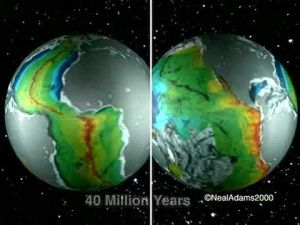
Adams presented these arguments chiefly through animation and video rather than through journals, and this proved to be their decisive advantage. His original expanding Earth animation — Conspiracy: Earth is Growing!, the first of his science films — has been viewed millions of times on YouTube, incomparably wider circulation than any paper on the subject has achieved, and almost certainly the single largest reason the idea is known to the public at all.
Its effect was not merely popular. The video drew people into the subject who went on to work on it seriously, among them David de Hilster, a founder of the John Chappell Natural Philosophy Society and of this wiki. Adams' animations are therefore part of the intellectual lineage of the expansion-tectonics material catalogued here, and not simply a piece of outreach.
Reception
Mainstream geology rejects the growing Earth. The standard objections are that palaeomagnetic and geodetic measurements constrain any change in Earth's radius to a very small value, that subduction is directly observed in seismic and geological data, and that no accepted physics generates matter from nothing in a planetary core — pair production requires energy input and conserves it, so it cannot serve as a net source of mass.
Adams' supporters reply that the reconstructions themselves are the primary evidence and have never been satisfactorily explained away, and that the mechanism is the weakest part of a case whose observational core stands independently of it. Researchers on this wiki generally accept the expansion while differing sharply from Adams about its cause.
Adams was the popularizer of a research tradition that this wiki documents in depth, and whose practitioners have examined both the evidence for expansion and the question of mechanism that his account leaves open:
- James Maxlow — the Australian geologist who coined the term Expansion tectonics in 1995 and who has modelled the entire 4,000-million-year expansion history from global geological mapping, providing the quantitative framework Adams' animations depict.
- Samuel Warren Carey — the Tasmanian geologist whose mid-century advocacy established the modern expanding-Earth case.
- A New Mechanism for Matter Increase within the Earth — addresses directly the problem Adams tried to solve with pair production.
- Subduction: The Extent and Duration — Adams' own contribution, arguing that subduction is insufficient to balance crustal creation.
- Are subduction zones actually mantle wedges upduction? ? A new interpretation of the Mediterranean arcs — reinterprets subduction zones themselves.
- A Test of Earth Expansion Hypotheses by Means of Palaeomagnetic Data and Are Artificial Satellites Orbits Influenced by an Expanding Earth? — test the hypothesis against the palaeomagnetic and geodetic data usually cited against it.
- Atlas of Continental Displacement, 200 Million Years to the Present and Biogeography in a Changing World — supply reconstruction and biogeographical evidence.
Further material is indexed under Category:Expansion Tectonics.
Abstracts
- 2011 - "Subduction: The Extent and Duration" (Read in full)
Media
- Conspiracy: Earth is Growing! (Science 01) — Adams' original expanding-Earth animation (Video)
- 2008 - The Growing Earth Theory (Audio Podcast)